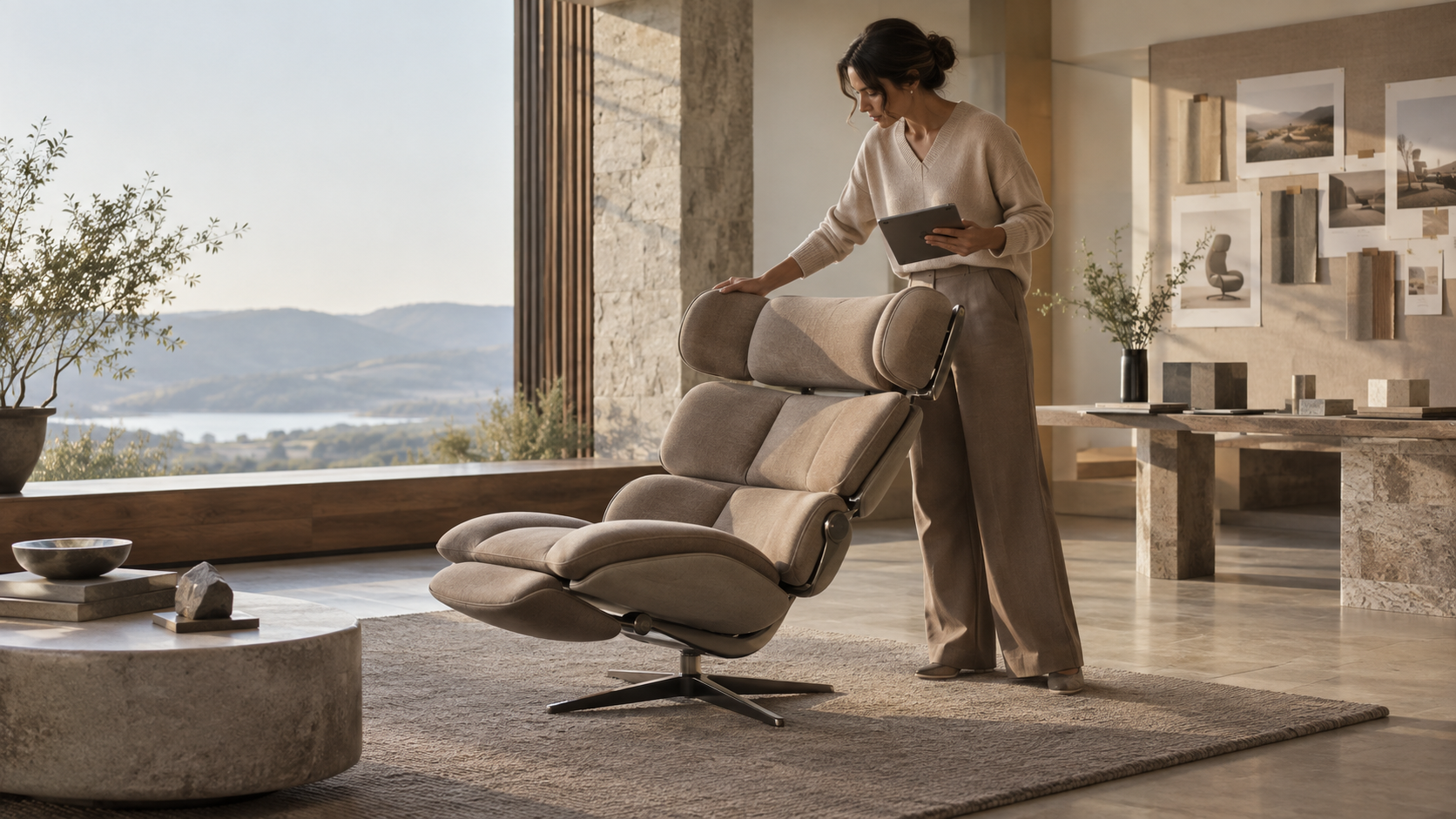
Configuring Adaptive Seating in Real Time on the Showroom Floor
with Dynamics People and Microsoft Dynamics 365
The Challenge
Our Client's research program explores a new kind of product: a polymorphic electromechanical seat that can physically
reconfigure itself to reproduce different comfort profiles.
The concept deliberately moves beyond a fixed catalogue. A single demonstrator must represent multiple seating
archetypes, each made up of configurations, elements, components, and adjustable attributes. The commercial experience
therefore depends on a product model flexible enough to describe options that are still evolving during research and
development.
The challenge was not limited to configuration data. Microsoft Dynamics 365 had to apply engineering rules, manage
dependencies, and communicate a confirmed configuration to an industrial controller so that the physical seat could
reshape itself. The complete experience also had to work from a tablet on the showroom floor, close to the customer
and the demonstrator.
The Solution: Microsoft Dynamics 365 and Industrial Integration
Dynamics People created an extensible five-level product structure in Microsoft Dynamics
365: Product Type, Configuration, Elements, Components, and Attributes. The model lets the research team add new
product families and comfort parameters without redesigning the whole application.
Two independent backend services keep responsibilities clear. The CRM service exposes configuration data and applies
business rules; the industrial service communicates with the seat controller. Once a configuration is complete, the
solution validates and resolves it, orders dependent commands correctly, and sends the result to the physical
demonstrator.
A dedicated mobile application brings the same process onto a tablet. Sales staff can guide the customer through
product selection, configuration, and adjustment while remaining beside the seat as it responds in real time.
The Role of Dynamics People
In a product where software choices trigger a physical response, technology creates value
only when engineering complexity disappears from the sales conversation.
Dynamics People translated an open-ended research concept into a working chain that connects product modelling,
configuration logic, industrial communication, and a customer-facing tablet experience. Its role covered the Dynamics
365 data model, the separation and orchestration of backend services, protocol integration, dependency management, and
the mobile interface used during demonstrations.
Microsoft Dynamics 365 provides the data model. Dynamics People turns it into the bridge between a sales conversation and a seat that physically reshapes itself in front of the customer.
An Extensible Five-Level Product Model
The solution organizes the product through five connected levels: Product Type,
Configuration, Elements, Components, and Attributes. Each level narrows the available choices while preserving the
flexibility required by an experimental platform.
Engineering rules in Dynamics 365 control compatibility and dependencies. This allows the application to prevent
invalid combinations and to resolve a customer's selections into a complete set of parameters the physical
demonstrator can execute.
Two Systems, One Confirmed Configuration
The architecture separates the CRM backend from the industrial-control backend. The first
manages products, choices, and rules; the second translates the confirmed configuration into commands for the seat
controller.
Communication with the demonstrator uses BLE, Modbus TCP, and OPC UA where appropriate. Commands are arranged in
dependency order and exchanged through a multi-step process with timeout management, helping the system handle the
sequencing required by physical components rather than treating the seat like a simple software endpoint.
A Showroom Experience Built Around the Customer
The tablet application keeps the interface close to the conversation. A salesperson can
select a product type, explore available configurations, adjust individual attributes, and send the result to the
demonstrator without leaving the customer's side.
The app can switch between development, test, production, and custom environments. This supports both controlled
experimentation and deployment in different contexts without changing the customer-facing interaction.
Key Benefits
• A product model designed for research — The five-level structure supports evolving seating archetypes, configurations,
components, and attributes without rebuilding the application.
• Engineering rules inside CRM — Compatibility and dependency logic turn customer choices into configurations that can
be validated and executed.
• A clean separation of responsibilities — Independent CRM and industrial services keep configuration logic distinct
from device communication.
• From digital choice to physical response — Confirmed configurations are translated into ordered commands and sent to
the electromechanical demonstrator.
• A guided showroom conversation — The tablet experience lets sales staff configure the seat beside the customer and
demonstrate its response in real time.
• Supported by national innovation funding — The initiative was developed within an Industry 4.0 research and
development program supported by Italy's Ministry of Enterprises and Made in Italy, with the Client as lead applicant
and Dynamics People involved in research and experimental development activities.
The Result
The experimental development phase concluded with all planned components built and
connected end to end: an extensible product model, rule-based configuration, two coordinated backend services,
industrial communication, and a mobile showroom application.
The result is a working foundation that demonstrates how Microsoft Dynamics 365 can connect a highly personal sales
conversation to a responsive physical product. Further refinement and industrialization remain the natural next phase,
while the completed work provides the Client with a concrete platform for continuing product and experience
development.